Untitled (Finestra Blu, Blue Window) Charcoal and Acrylic on Canvas 48 x 36 in 2024
I sat down at a local eatery and had in front of me this view behind two unoccupied tables. Perhaps it was the mundane quality of it, instead of the more important vase of flowers on top of the tables for instance. I created the sketch on location and at the time I knew I would eventually make a painting of it.
Untitled ( Burle Marx No Shopping ) Pencil on Paper, 10 x 7 in, 2023
According to an architect friend, world famous Brazilian landscape designer Roberto Burle Marx created the garden depicted in this drawing. The garden is located inside a nondescript shopping mall in a small town in the interior of São Paulo state.
I had been visiting Brazil a few years back, and I headed to the mall to check out their bookstore.
When I came across the garden it had just finished raining. The mall’s roof had openings above the garden, and you could feel nature inside the building.
This is not by any means a glamorous Roberto Burle Marx project. It resides in a humble location, but that is what makes it so special.
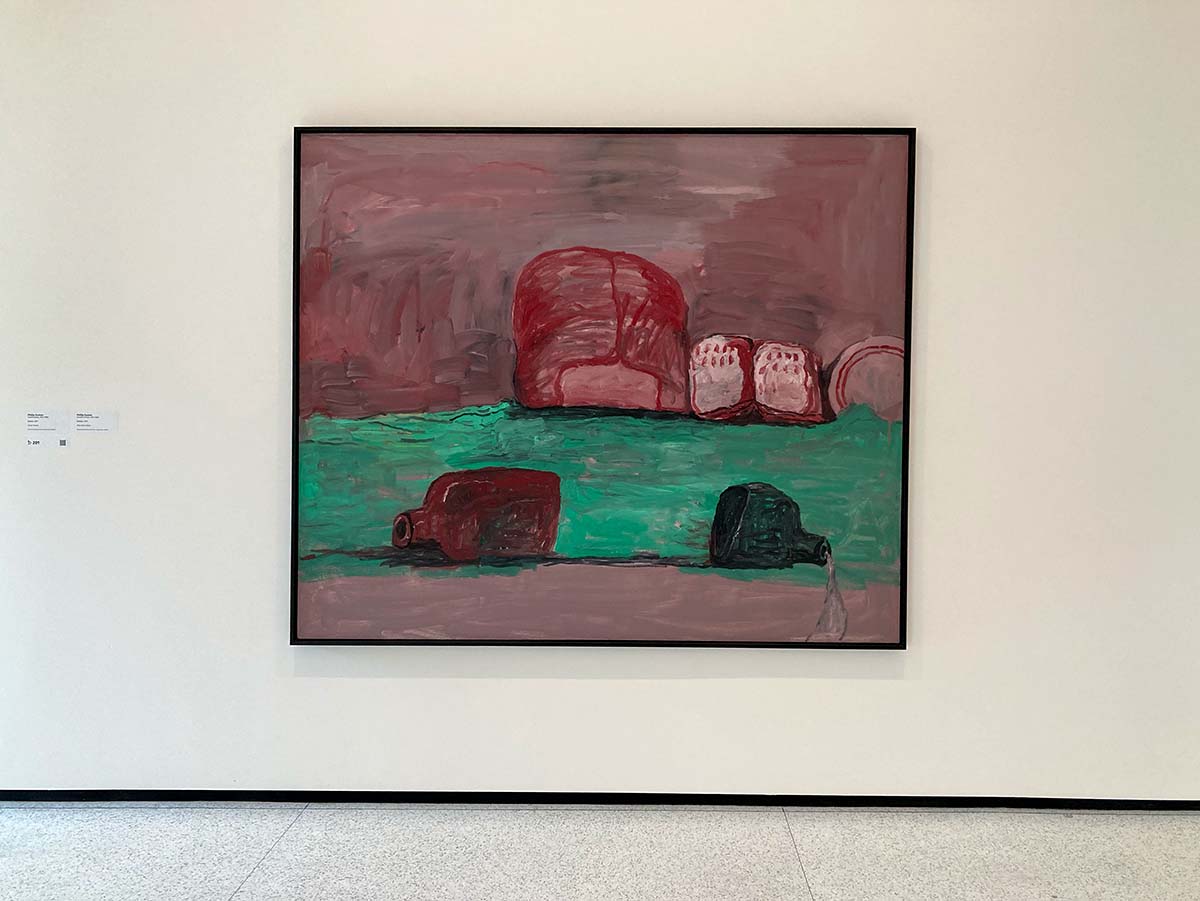
There is a variety of cool art currently on display at the Museum of Contemporary Art, La Jolla in San Diego. But as far as pushing paint on the surface of a canvas, nothing comes near this painting by Philip Guston ( 1913 – 1980 ). And don’t get me wrong, a few yards away there is a beautiful little Mark Rothko that is not too shabby either.
After contemplating Bottles for several minutes, and making a sketch of it, I walked around the room to see the other artworks.
This painting was in a spacious gallery with many other contemporary “important” pieces, including a marble sculpture by Ai Weiwei.
I went back to the Guston, and when the security guard looked in my direction, I remarked: “Best painting currently on display in this museum”. He said he agreed with me, even though his focus as an artist was music, and he really couldn’t articulate why he liked the painting.
“Bottles” is not a particularly chirpy piece. In it, Philip Guston was confronting his alcoholism: he wore his addiction on his sleeve, creating many many variations on this painful theme.
It is a beautiful work of art nonetheless. If you like painting, that is.
When the security guard looked in my direction, making eye contact with me, I told him: “Best painting among all the ones currently on display in this museum”.
We can see an accomplished artist having fun with painting, not unlike a child playing with his first set of color crayons. The traces of the wet on wet process, each brush stroke visible, the messy interaction of the different colors in the background, everything happening at the same time. It’s both a powerful and humble painting.
If you walked away feeling jealous, wishing you had done it, it’s ok. Good painting will do that to you.
Untitled ( “I’m a Materials Girl” “Xou da Xuxa” ) Tape, Aluminum, Acrylic, Charcoal on wood, Medium 2024
I was reading the book Wabi-Sabi – The Japanese Art of Impermanence – Understanding the Zen Philosophy of Beauty in Simplicity while working on this painting.
“Wabi sabi embodies the Zen nihilist cosmic view and seeks beauty in the imperfections found as all things, in a constant state of flux,…”
At first I did not feel the piece was done, and I intended to continue working on it. As I grappled with it, the information from the Wabi sabi philosophy helped me understand the piece was OK at this particular stage in the process. Therefore I left it alone, as you see here.
Some of the Wabi sabi “rules” I believe apply to Untitled (CAL) 2023:
“Color – Design criteria:
no harsh or strong colors.
Texture – Design criteria:
Asymmetry or irregularity
The form comes from the physical properties of the materials used.
Left: Untitled (Blu) Oil on canvas, 2017 Middle: Untitled ( Alexanders still life ) Right: Untitled ( Pink Tulip ) Oil on canvas, 2017
In 2021 Augusto dined at Alexander’s in North Park, San Diego, CA. That was during the tail end of the COVID-19 pandemic and they were passing out paper menus. He took advantage of that to create a sketch of one of the floral arrangements.
Alexanders Still Life – 2021, pencil on back of menu
Title: Untitled (TAMALES) Charcoal and acrylic on canvas, 2022
According to Augusto, he was doodling with a vector program, and the process revealed the starting point for the drawing paintings.
“I was trying to make brushes, which I’d use to eventually draw with the brush tool…”
The first building block, the striped square in the image above.
After many different trials, Augusto decided on the composition in the image below.
He had to make additional custom forms, such as the corners, the only parts that aren’t made from the initial building block.
In the non-digital ( the image at the very top ), Augusto created the drawing layer using charcoal with a straight edge. The curved lines were hand drawn and sometimes they were re-drawn/erased multiple times until Augusto felt they were correct.
Vestiges of the mistakes, smudges, are not erased. They are the tracks left behind from the interaction with the surface as the drawing is created.
The lettering is stenciled using painter’s tape. It’s not a very efficient process, since the porosity of the canvas surface, and the relatively crude stencil. Each letter is painted separately, until it dries, then the tape is peeled off and the next letter is painted. It’s a time consuming and inefficient endeavor, but Augusto claims it is the method that provides the best results for him.
“If they were perfect or letterpress-like, then I would not enjoy the making of the painting nearly as much; and I do not believe the end result would be as appealing.”
Middle floor, Untitled (Hemera) reclaimed wood sculpture – collection of the artist
Studio, Claremont, CA – 2014
Everything was happening at the same time. Sometimes paintings were made with tape exclusively, with reclaimed materials, or just paint. Additional bodies of work sprouted from the works in this picture. No cookie-cutter template, or imposed consistency on the production of each piece. Non-Objective painting or Non-Objective abstraction is what they have in common: as in the explanation by the Tate Museum:
“a type of abstract art that is usually, but not always, geometric and aims to convey a sense of simplicity and purity”.
The What to do with small paintings? question led to the way of the arranging of these works as in the Radius Abstractus installation at University of La Verne, CA in 2014 – 2015. Augusto embraced The Tall Wall Space exhibiting area with a cluster of over 20 abstract paintings linked to a central cardboard wheel with aluminum tape strips.